
Spring 2026 Davis Industrial Report
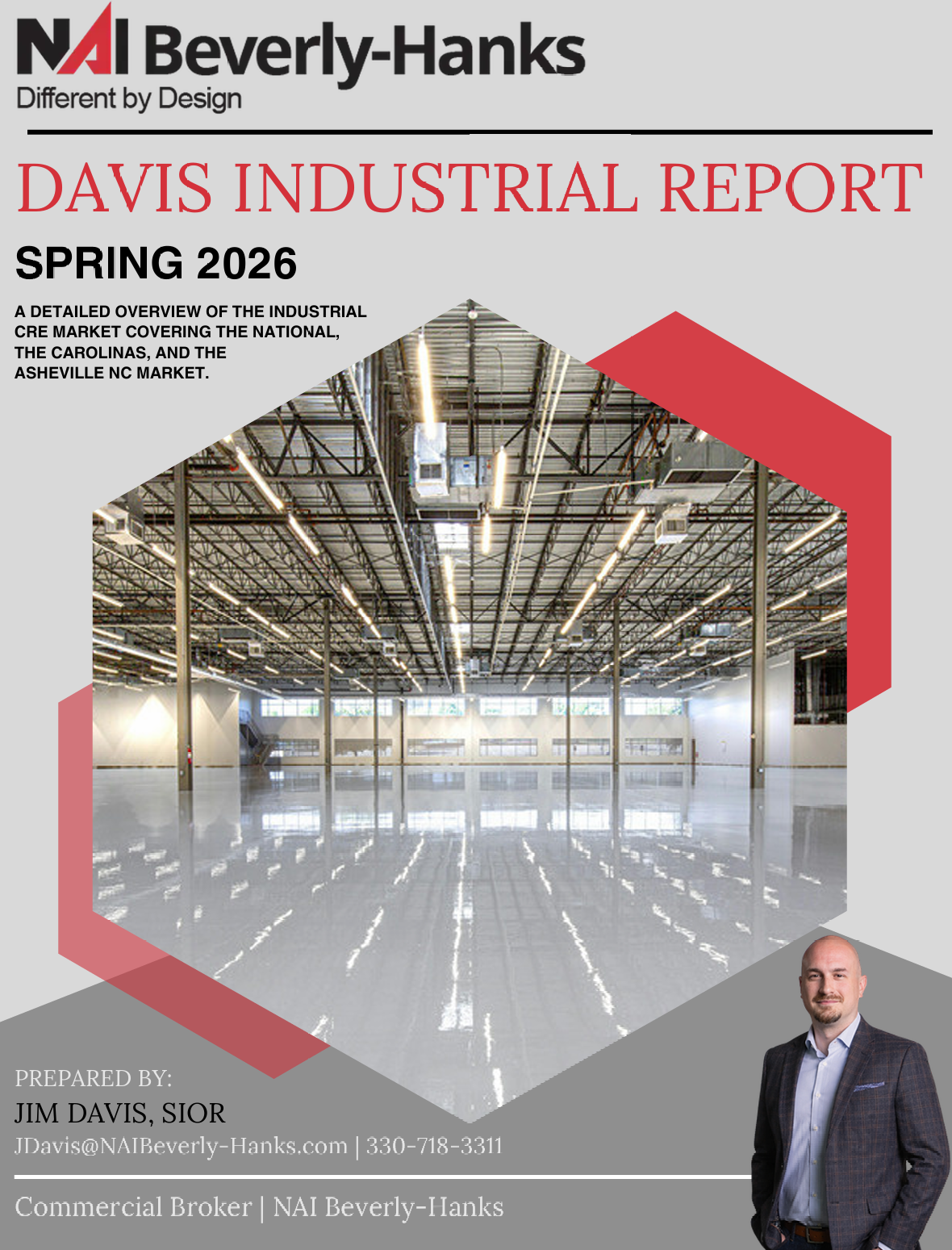
Industrial Market Insights for Asheville, Western North Carolina, the Carolinas & Beyond
Looking for a clear read on the industrial market in 2026?
This report breaks down the key trends shaping industrial real estate at the local, regional, and national level — helping owners, investors, developers, and occupiers better understand where the market stands and where opportunities may be emerging.
🔍 What’s Inside the Report?
The Spring 2026 Davis Industrial Report covers:
Asheville & Western North Carolina industrial trends
Key takeaways from the Carolinas’ strongest markets
A national industrial market snapshot
Vacancy, rents, supply pipeline, absorption, and pricing
Major themes to watch for investors, developers, and owners
📍 Asheville & WNC: Tight, Selective, and Still Resilient
Western North Carolina remains an interesting industrial story.
Asheville continues to operate as a relatively tight secondary market, with approximately:
36.9 million SF of inventory
4.0% vacancy
5.8% availability
$10.34/SF average asking rents
The market is no longer being driven by scarcity alone. New construction has increased, absorption has softened, and performance is becoming more asset-specific. Still, this is not a bearish market — it’s a more selective one.
Key local themes include:
Henderson County emerging as the region’s growth engine 🚛
Asheville infill product continuing to benefit from supply constraints
Stronger pricing for functional smaller-bay industrial properties
Recovery-related public investment helping support broader commercial activity
Bottom line:
WNC industrial remains balanced, with solid long-term fundamentals and continued demand for well-located, functional product.
🌎 The Carolinas: Still a Regional Leader
The Carolinas continue to be one of the most compelling industrial regions in the country — but in 2026, not every market is moving in the same direction.
Markets showing some of the strongest momentum:
Charlotte
Greenville-Spartanburg
These areas are seeing solid absorption, better tightening trends, and more encouraging supply-demand balance.
Also covered in the report:
Charleston: improving as excess supply works through the system
Raleigh-Durham: strong long-term outlook, though currently more tenant-friendly due to a larger pipeline
The takeaway:
The Carolinas still deserve serious attention, but the market is rewarding the right product in the right location, not broad exposure alone.
U.S. Industrial Market: Moving Toward Stabilization
Nationally, industrial real estate has shifted from broad rebalancing into early stabilization.
While vacancy remains above the ultra-tight levels seen in recent years, the market is showing signs of improving health:
Leasing activity is improving
Supply pressures are easing
Market softening has slowed
Capital markets are becoming more constructive
One of the biggest national themes is the widening divide between:
✅ Modern, functional industrial product
and
⚠️ Older commodity inventory
That distinction is becoming increasingly important for both leasing performance and investment underwriting.

💡 Why Download the Full Report?
The full report goes beyond headlines and gives you a clearer picture of what’s actually happening in the industrial market.
It’s designed for:
Property owners
Investors
Developers
Business owners / occupiers
Anyone tracking industrial real estate in WNC and the Carolinas
Inside, you’ll get:
More detailed market commentary
Key stats and context by region
Insight into what matters most in today’s industrial environment
A practical view of where opportunities — and risks — may exist
📥 Download the Full Spring 2026 Davis Industrial Report
Want the full breakdown?
Download the complete report for a deeper look at the industrial market across Asheville, WNC, the Carolinas, and the U.S.
Prepared by:
Jim Davis, SIOR
Commercial Broker | NAI Beverly-Hanks
📧 JDavis@NAIBeverly-Hanks.com
📞 330-718-3311
🌐 www.AshevilleCRE.com